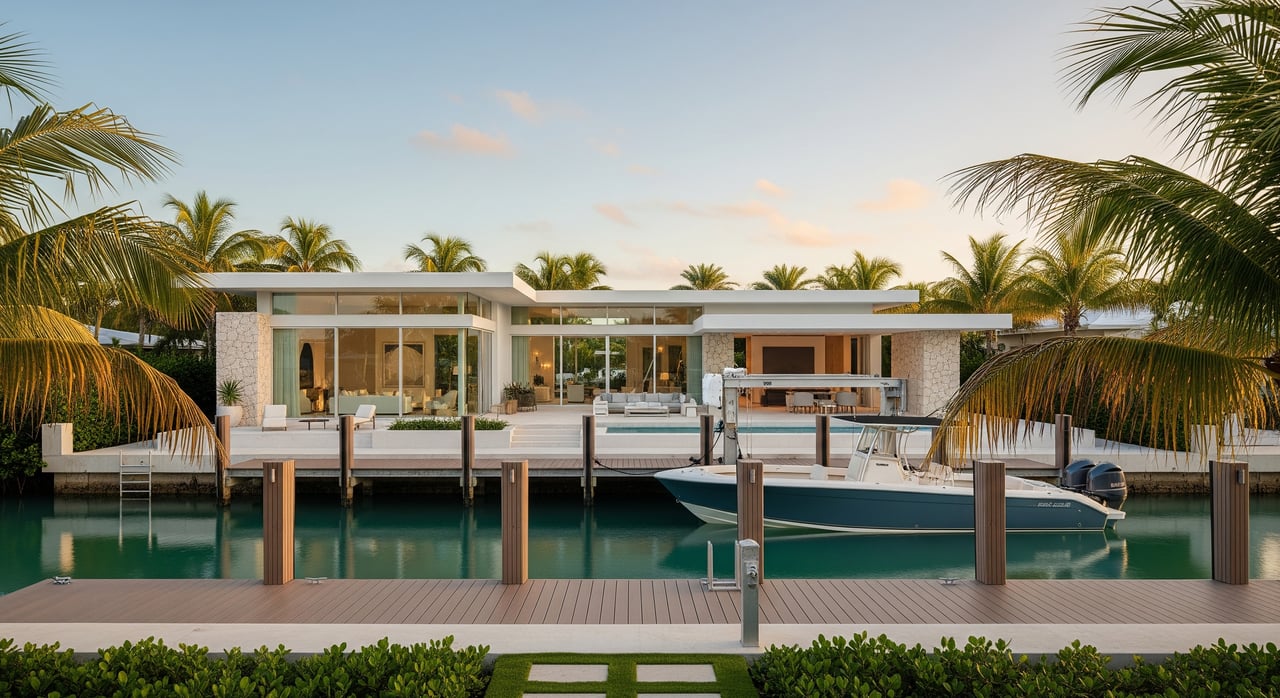
Considering a canal home in Tavernier but not sure how to tell if the dock really fits your boat or lifestyle? You’re not alone. In the Upper Keys, two streets apart can mean very different canal widths, depths, and bridge clearances. In this guide, you’ll learn exactly what to ask, what to measure, and how to match a Tavernier canal property to your boating plans with confidence. Let’s dive in.
Why Tavernier canal homes
Tavernier sits in Monroe County in the Upper Florida Keys, where canal-front neighborhoods connect out to Hawk Channel and nearby waterways. Many canals were dredged decades ago and conditions vary by block. That is why you want to verify details before you fall in love with a listing photo.
Canal homes offer quick access for fishing, diving, and sunset cruising. They also come with real-world variables, like shoaling, tidal depth, and bridge heights. A careful review today helps you avoid surprises after closing.
Canal geometry that matters
Canal geometry controls what you can safely dock and how you will maneuver. Focus on three numbers: width, depth at low tide, and turning basin size.
Canal width
Width affects whether you can turn in the canal, side-tie, or pass another boat safely. As a rule of thumb:
- Narrow canals around 30 to 45 feet often suit smaller runabouts under about 25 to 28 feet.
- Moderate canals around 45 to 75 feet handle mid-size boats from about 25 to 40 feet more comfortably.
- Wide canals around 75 to 120 plus feet can support larger boats around 40 to 60 feet and often allow turning in the canal.
Treat these as general ranges. Request a measured width at the property frontage and at the nearest turning basin.
Depth at low tide
Depth is usually stated at a tidal datum, most commonly mean low water, also called MLW. Ask for the depth at MLW. Do not rely on a generic “deep water” claim. Keys canals vary widely. Some show depths in the 4 to 8 foot range at MLW while others are deeper if maintained. Depths also change over time. Request a recent sonar or bathymetric reading dated within the last 6 to 12 months.
Turning basins
A turning basin is the wider area in a canal where you can pivot a vessel to enter or exit a dock. For safe, stress-free turns, the clear turning diameter should be around 1.5 to 2 times your boat’s length overall. A 40 foot boat benefits from 60 to 80 feet of clear space. A 50 foot boat benefits from 75 to 100 feet or more. Wide-beam boats and boats that need more rudder authority may need extra margin.
Bridges and air draft
Two measurements matter at bridges: vertical clearance and horizontal clearance. Vertical clearance, also called air draft, is the distance from the waterline to the underside of a fixed bridge. Horizontal clearance is the navigable opening width between piers.
- Fixed bridges limit towered center consoles, sportfishermen, and sailboats by height.
- Opening or bascule bridges are less common on residential canals and can have operating schedules.
Ask the seller or listing agent for exact vertical clearance numbers and the datum used, such as clearance at mean high water. Verify whether any bridges on the route to open water are fixed or opening and whether there are restrictions. Tides and storm surge affect clearances for taller vessels, so confirm clearances at the relevant tidal stage.
Docks, lifts, and permits in the Keys
Docks and seawalls in Monroe County are highly regulated. Plan to review permits and as-built drawings as part of your due diligence.
Dock types you’ll see
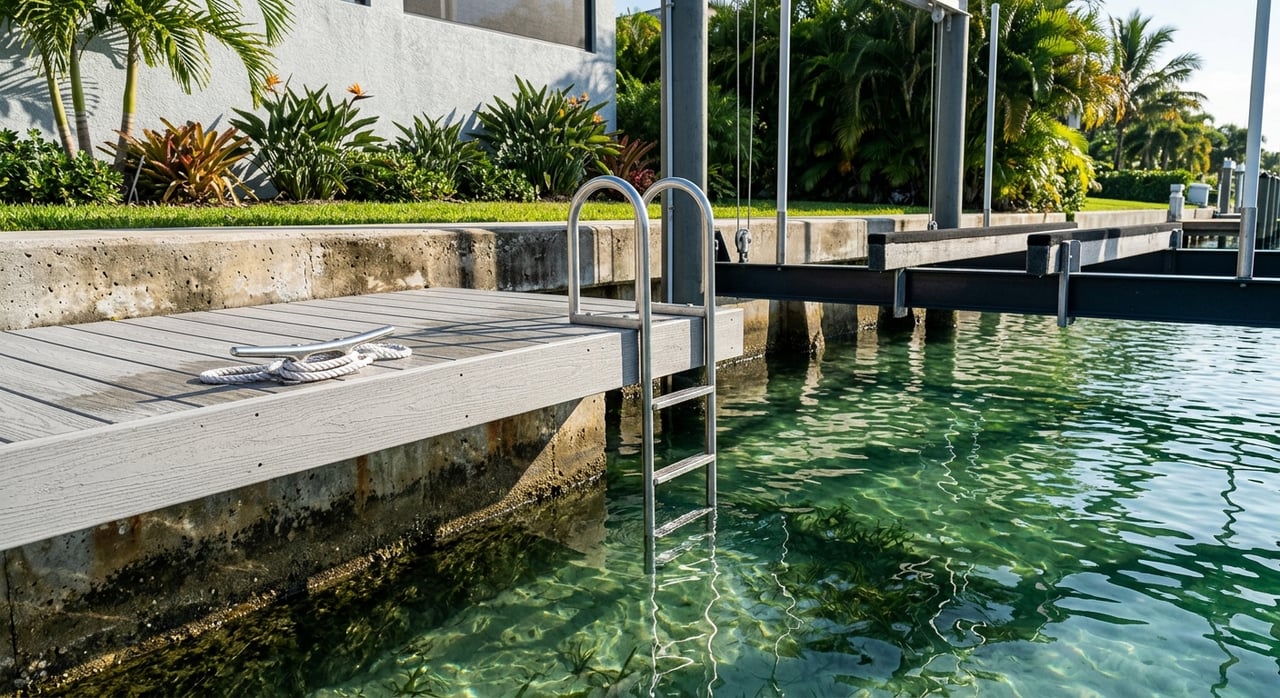
- Side-tie dock. Runs parallel to the canal and is common in narrow canals.
- Finger piers. Short walkways off a main dock or bulkhead that allow side-tie.
- T-docks. Extend out with a crosspiece to create more mooring edge or reach deeper water at the face.
- Pile-supported docks. Pilings driven into the seabed with decking on top, common across the Keys.
- Floating docks. Rise and fall with the tide and improve boarding when water levels change.
- Davits and boat lifts. Useful for reducing hull fouling and storm risk, often require permits.
Utilities and on-dock gear
Look for shore power capacity such as 30 amp or 50 amp, water service, adequate cleats, fenders, and lighting. Private fueling is not typical on residential docks, so note where the nearest marina fuel is located. In the Keys, hurricane preparedness matters. Rated lifts, sturdy pilings, and well-designed tie-downs improve resilience.
Permits and environmental rules
Most docks, lifts, and seawalls require permits from Monroe County and may also require state and federal approvals. Mangroves, seagrass, and other submerged vegetation are protected resources. Dredging and maintenance dredging are restricted and can be costly, and many private canals are not actively dredged. Ask for copies of permits and any records of recent work. If a dock extends far into the canal, confirm it does not encroach into the navigable channel.
How to read Tavernier listings
Listing language can be inconsistent. Use the terms below as signals to ask for specifics.
- Canal-front or waterfront. Confirms canal adjacency, not width or depth. Request measurements.
- Direct ocean access or open water access. Often implies no low fixed bridges to the ocean. Verify the route and bridge clearances.
- No fixed bridges. Good sign for tall boats, but confirm the entire path, not just the first basin.
- Deep water dock or deepwater canal. Request numeric depth at MLW and a recent survey.
- Private dock versus community dock. Clarify ownership, rules, and slip allocation.
- Bulkheaded or seawall. Ask for condition, permits, and installation date.
- Dredged canal. Ask who maintains dredging, the schedule, and the last dredge date.
- T-head or T-dock. Request dimensions and water depth at the T-head.
Buyer checklist: verify before you offer
Use this checklist to organize documents and measurements before you finalize a contract:
- Numeric canal width at the property and at the nearest turning basin, with measurements.
- Depth at the dock and along the approach path at MLW, with survey date and method.
- Bridge information along the route to open water, including vertical clearance with the stated tidal datum and any operating schedules.
- Copies of permits and as-built drawings for the dock, lift, and seawall, including structural specs.
- Records of dredging history, responsible party, and any cost-sharing.
- HOA covenants or deed restrictions on boat size, number of vessels, and dock use.
- Confirmation of no open county or state violations tied to the dock or seawall.
- Recent inspection photos and reports for pilings, decking, electrical systems, and lifts.
- Preliminary homeowner and marine insurance quotes that reflect actual dock and canal conditions.
- Notes on nearby marinas and typical tide windows if the canal is shallow.
Smart questions to ask the seller
- What is the canal width at the property and at the nearest turning basin, and do you have measurements?
- What is the depth at the dock at mean low water, and is there a recent sonar or bathymetric survey?
- Are there any fixed bridges between this property and open water, and what are the vertical clearances with datum?
- Are the dock, lift, and seawall permitted, and can you share permit documents and as-builts?
- Who maintains the canal and is there a dredging schedule, and have there been shoaling issues?
- Are there HOA or county rules on boat length, beam, or motor type?
- How has the dock performed in recent storms, and what hurricane preparation is in place?
Match boat and lifestyle
Choose canal features that match how you use the water. Here are practical fits.
Small boats and paddlesports
If you run a 15 to 25 foot skiff or center console, narrow canals around 30 to 45 feet can work well. You can side-tie on a simple dock or small T-dock. Depth needs are modest, and upkeep tends to be lower.
Mid-size powerboats
For 25 to 40 foot center consoles or express boats, look for moderate canal widths around 45 to 75 feet. A turning basin with 1.5 to 2 times your length overall makes docking easier. Depth at MLW of around 4 to 6 feet or more is often needed depending on draft. Shore power and water at the dock are helpful.
Large sportfisher and motor yachts
If you plan for 40 to 60 plus feet, prioritize wide canals or properties near open water with a generous turning basin. Depth at MLW often needs to be in the 6 to 10 plus foot range depending on draft. You may need a full T-head, heavy-duty pilings, and higher amperage power. Expect to rely on marinas for some services.
Sailboats
For sailboats, vertical clearance is often the limiting factor. Ensure the entire route to open water has adequate bridge clearance for your mast at the published tidal datum, and verify consistent depth for your keel.
Verification resources
For official answers, consult the local and state agencies that oversee permitting and navigation. In Tavernier and Monroe County, these include county planning and environmental departments for dock and seawall rules, state agencies for dock and mangrove impacts, and federal agencies for work in navigable waters. For bridge clearances, review published figures from transportation and maritime authorities, and for navigation and tides, rely on nautical charts and local notices to mariners. Your goal is to confirm numbers with current, authoritative sources.
Your next steps in Tavernier
- Define your boating profile by length, beam, draft, and air draft.
- Shortlist properties and request canal width at frontage, MLW depths, turning basin size, and bridge data with the tidal datum.
- Gather permits, as-builts, and maintenance records for all dock and seawall elements.
- If you plan a larger vessel, consider a pre-offer sonar depth check or marine survey focused on approach depth and maneuvering.
If you want a calm, expert process from first tour to closing, connect with a local advisor who lives the Keys lifestyle and understands canal specifics. For a high-touch, multilingual approach and precise waterfront due diligence, reach out to Pierre-Marc Bellion.
FAQs
What canal width works for a 30 foot boat in Tavernier?
- A moderate canal around 45 to 75 feet generally makes docking and passing safer for a 25 to 40 foot boat, with a suitable turning basin nearby.
How do I confirm “deep water” at a Tavernier home?
- Ask for a numeric depth at mean low water with a recent sonar or bathymetric survey, and verify depth at the dock and along the approach path.
How do bridge clearances affect my purchase?
- Fixed bridges limit air draft; request published vertical clearance with the tidal datum and confirm every bridge on the route to open water.
Do I need permits for a lift or dock work in Monroe County?
- Most docks, lifts, and seawalls require permits, and work affecting mangroves or seagrass also needs state and federal approvals—request existing permits and as-builts.
Who maintains canal depth in Tavernier neighborhoods?
- Maintenance varies; some canals are privately maintained while others are not dredged on a schedule, so ask who is responsible and when dredging last occurred.
What turning basin size should I look for?
- Aim for a clear turning diameter around 1.5 to 2 times your boat’s length overall, with more space for wide-beam or heavy vessels.
What utilities should my dock have for a mid-size boat?
- Shore power such as 30 amp or 50 amp and water service are helpful, along with proper cleats, fendering, and lighting.