Ask a longtime Key Largo boat owner where they haul out and you will often hear "Catamaran" even though that name has not been on the sign at Mile Marker 98 for a few years now. The yard changed hands, changed its name to Key Largo Boatyard & Storage, and by most accounts changed for the better under an owner named Ricardo who took over what had been a rough patch for the place. But muscle memory is strong in a small town, and half the boats that show up there in September still arrive because someone's captain buddy said "just go to Catamaran, you'll be fine."
That gap between what people call a place and what it has actually become is worth paying attention to, because it points to the real mechanic behind storm season here. Everyone assumes the hard part of prepping a boat for a hurricane is deciding whether to stay in the water or come out. The harder part, the one nobody mentions until they are stuck, is that dry ground and travelift time in Key Largo are finite and they get claimed on a schedule that has nothing to do with whether a storm is actually coming.
The Yard Everyone Still Calls "Catamaran"
Key Largo Boatyard & Storage sits oceanside on Mile Marker 98, on four fenced acres, with an 85-ton travelift wide enough to handle catamarans and wide-beam sportfishers up to 80 feet long and just over 27 feet across. That width matters more here than in most boatyards, since the Upper Keys have a real population of cats and center consoles with outboard clusters that narrower lifts simply cannot straddle. The yard runs both DIY and full-service tracks, so an owner who wants to do their own bottom job can rent the space and the lift time without paying a crew, while someone who wants to hand off the whole job can do that too.
The reason this matters for storm planning specifically is that reputation takes years to catch up to reality, and in the meantime a genuinely solid option gets underbooked relative to how good it actually is. If you have written this yard off because of what it used to be, you are the exact person for whom that information gain matters.
Why Rack Space Runs Out Before the Cone Does
Here is the part that catches people off guard even after a decade of Keys summers. Boat owners tend to think of storm prep as a five day countdown that starts when the National Hurricane Center draws a cone over South Florida. Boatyards do not work on that timeline. Dry rack space, travelift slots, and DIY yard spots get reserved by the boat owners who plan for the season as a whole, not the storm as an event. By the time a system is close enough to have a name and a cone, the yards with hurricane-specific capacity are often already down to whatever slots their regular seasonal customers did not use.
Keys Marina, operated by Bowline Marinas in north Key Largo, markets this directly. Their listed hurricane preparation services include haul-out and secure storage during storm season, with an explicit note that advanced planning and reservations are recommended. That phrase is doing real work. It is a polite way of saying the yard fills from the calendar backward, not from the forecast forward.
Marina Club Key Largo, up at Mile Marker 104, runs a rack system where boats come off the rack fully fueled in the time it takes the owner to arrive, but racks are limited and must be reserved in advance even in a normal week. Multiply that scarcity by the number of owners who all decide to move at once when a storm enters the five day window, and the math explains why the smart move is a standing relationship with a yard, not a phone call once the euphemistically named "invest" becomes a tropical storm.
The Different Kinds of Storm Room in Town
Not every yard offers the same thing, and knowing which kind of capacity you actually need saves a frantic call during the one week everyone else is making the same call. Key Largo's options roughly break into four categories.
- Full travelift haul-out with dry storage. Key Largo Boatyard & Storage and Key Largo Harbor Marina both fall here, with travelifts rated at 85 tons and 80 tons respectively. This is the option for larger sportfishers, catamarans, and anything too big for a trailer.
- Rack storage with valet-style launch. Marina Club Key Largo and the newer Keys Marina both run dry rack systems where the yard handles the lift and launch for you. This suits center consoles and smaller cruisers whose owners want their boat ready to go without doing the lifting themselves.
- DIY yard space. Key Largo Boatyard & Storage keeps this option open for owners who want to do their own bottom work or their own storm prep without paying full-service labor rates.
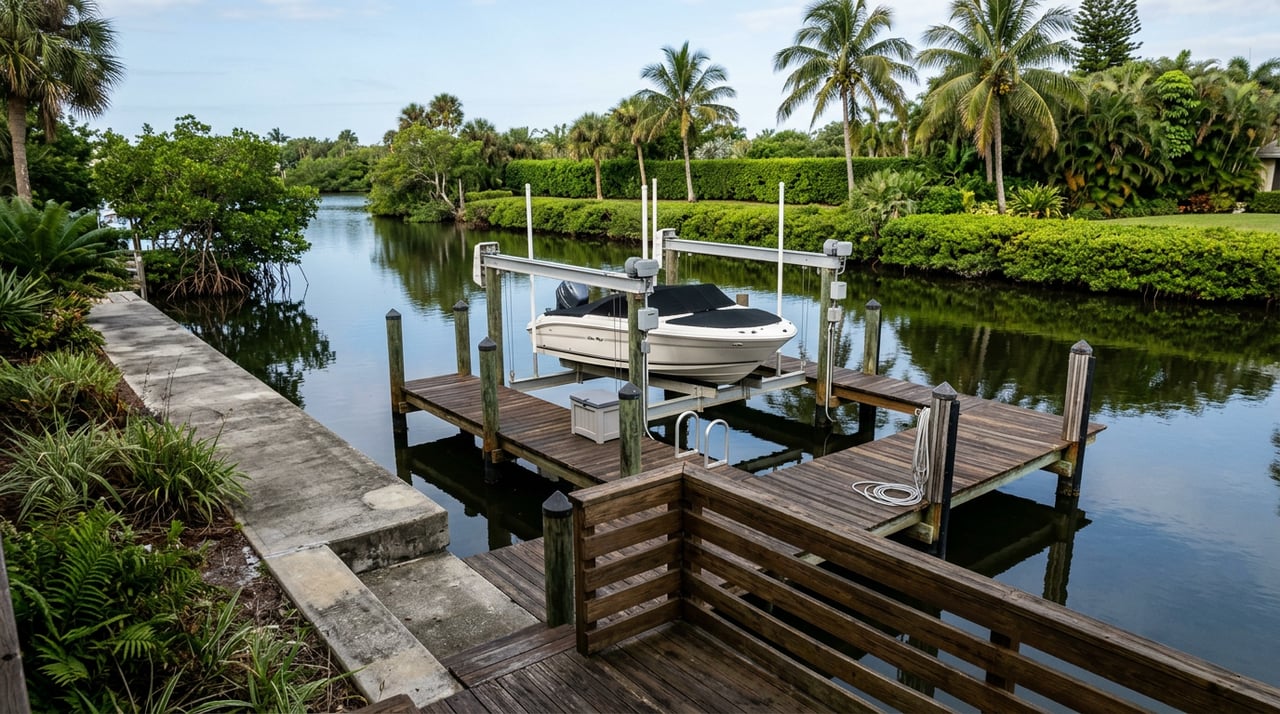
- Wet slip with hurricane protocol. Key Largo Harbor Marina and others keep boats in the water year round but have storm procedures for double lines and chafe protection rather than pulling every boat.
Matching your boat and your comfort level to the right category before hurricane season peaks is the actual decision, not which yard has the best reviews in a general sense.
One Town Over, a Different Kind of Insurance
Some Key Largo boat owners keep a second relationship with a yard in Tavernier as backup, and the one that comes up most often is Mangrove Marina, sometimes still called Boatman's Grove by people who have been coming for years, at Mile Marker 92 on the bayside. It sits in a natural hurricane hole with mangrove shoreline providing wind and wave buffering that open water marinas cannot match, and it offers haul-out, storage, and DIY work similar to the Key Largo options. For owners whose home yard is full or whose boat is too large for the local travelift, having a second option a few miles down US-1 is the kind of redundancy that only becomes obvious the week it matters.
What This Season Actually Looks Like
None of this is meant to manufacture urgency where there is none. The 2026 Atlantic season has been forecast as below normal, driven by a strengthening El Niño pattern that increases wind shear across the tropical Atlantic and tends to tear apart storms before they can organize. Two named storms, Arthur and Bertha, had formed by early August, both in the Gulf, and NOAA's forecasters put the odds of a below-normal season at 75 percent as of their August update.
Below normal is not the same as none. September is still, by a wide margin, the most active month of the season, and NOAA's own messaging after Arthur's rainfall in Louisiana was that residents should prepare for every storm projected to affect their area regardless of whether it reaches hurricane strength. For a Key Largo boat owner, that translates simply. The season being quiet so far is not a reason to skip the planning conversation with a yard. It is the reason you still have time to have it before everyone else does.
If you already have a boat here, you already know the water better than any outsider ever will. The only thing worth adding is this: the yard you use should be chosen in June, not in the forty eight hours before a storm gets a name. Call ahead, ask what their hurricane haul-out policy actually is, and find out now whether your slip in the yard is guaranteed or first come.
If you are weighing a move to Key Largo and boat ownership is part of that picture, dock access and proximity to a working boatyard are worth walking through with someone who knows which yards actually deliver on what they promise. That is a conversation Pierre-Marc Bellion has with clients regularly, well before any storm is on the map. Receive Exclusive Listings and get in touch to talk through what waterfront access really looks like day to day in the Upper Keys.