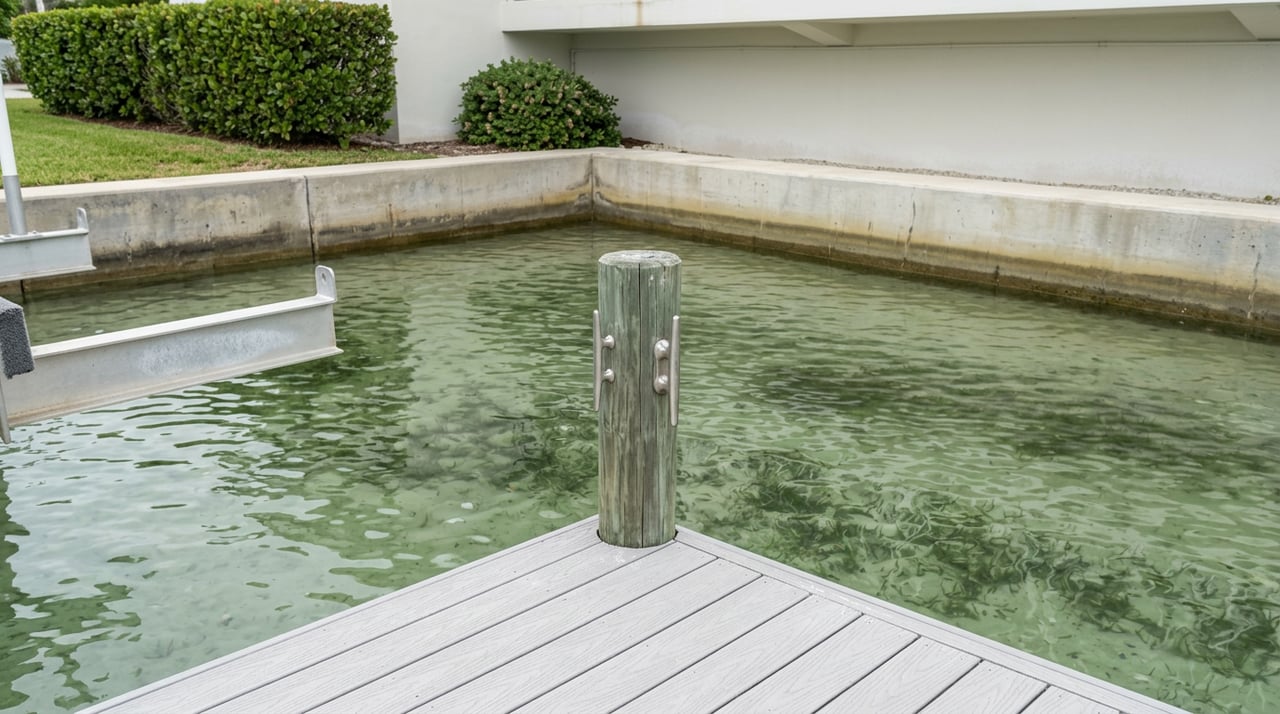
In March 2023, a Plantation Key homeowner named Dave Boerner stood up at a Village Council meeting and told the room he had bought his property specifically because the canal behind it was deep. Seventeen feet deep, by his account, right off his dock. The Village's environmental team wanted to fill it in. Not entirely, but enough to fix a water quality problem that had left the canal stagnant. Boerner's boat drew 5.5 feet. He was not against clean water. He was against losing the depth he'd paid for. The council tabled the vote.
That single objection captures something almost no one explains to a buyer comparing canal-front homes in Islamorada: the same program designed to make a canal healthier can make it shallower, and shallower is not automatically better, even when the water is clearer. If you are shopping canal-front here, the dockage length on the listing sheet tells you less than the canal's number does.
The Village Is Not Managing One Canal Problem, It's Managing Sixty-Two Separate Ones
Islamorada sits on four islands connected by decades of dredge-and-fill development, and the Village now maintains roughly 62 residential canals, ten of which the Village itself rates as poor quality. Many were cut straight and deep in the 1950s and 60s with no thought to circulation, which is exactly why some of them still don't flush properly today. A canal that looks identical to its neighbor on a map can behave completely differently underwater depending on how it was originally dug, whether it dead-ends, and how far it sits from open tidal exchange.
Each of these canals has a number. The Village tracks them individually in a public ranking system, and that number is the single most useful piece of due diligence a buyer can pull before writing an offer, because it tells you where that specific stretch of water sits in a restoration queue that has been running, canal by canal, for over a decade.
What "Restoration" Actually Means, and It's Not the Same Fix Everywhere
The Village's environmental resources manager, Peter Frezza, has overseen a rotating set of techniques depending on what's wrong with a given canal. Canal 116 on Plantation Key got a full backfill, completed in January 2024, which reduced the canal's depth to roughly 7.6 feet at mean lower low water and eliminated the low-oxygen dead zone at the bottom. Within a year, monitoring showed seagrass and macroalgae covering about half the canal floor, along with the return of ten fish species and even starlet coral. That is a genuine before-and-after story, and it's a fair one to point to if you're evaluating a home on that stretch.
A few miles south, on Lower Matecumbe, canals 155 and 157 are getting a different treatment entirely. An $8.9 million project, the most expensive the Village has taken on, is installing box culverts under Sandy Cove Avenue to hydrologically connect the two dead-end canals to each other and improve tidal flushing, work that began in November 2025 and was still underway as of the most recent public reporting in January 2026. Frezza has said the goal is better water quality and, potentially, higher property values along the way. Other canals have gotten air curtains, oxygenation systems, or organic matter removal depending on what a site assessment found.
Here's a quick way to see how differently these projects can land on the same map:
| Canal | Location | Method | Status |
|---|---|---|---|
| 116 | Plantation Key | Backfill to 7.6 ft MLLW | Completed Jan 2024, seagrass and coral returning |
| 155 & 157 | Lower Matecumbe (Sandy Cove Ave) | Culvert connection between dead-ends | Under construction as of Jan 2026 |
| Others across the system | Various | Air curtains, injection wells, organic removal | Mixed, canal-by-canal |
No two of these fixes change a waterfront lot the same way, and none of them show up as a line item on a listing sheet.
The Trade-Off That Doesn't Make It Into the Marketing Photos
This is the part that gets skipped in most conversations about waterfront value. A canal rated "poor" by the state isn't just an environmental footnote. It's often a canal with a stagnant bottom, low oxygen, and murky water right off the seawall, none of which photograph well and all of which a buyer notices the first time they stand on the dock at low tide. Fixing that is genuinely good for the property. But the most common fix, backfilling, works by reducing the very depth that lets a serious boat sit comfortably at the dock. Boerner's objection wasn't a fringe complaint. It's the built-in tension of the entire program: water quality improves when canals get shallower and better connected, while boating capacity is best served by canals that stay deep, even if that depth is part of what made the water stagnant in the first place.
So the honest way to frame it for a buyer is this. A canal still on the Village's waiting list may have better boat depth and worse water. A canal that's already been restored may have better water and a lower controlling depth than it had five years ago. Neither condition is disqualifying. Both are facts a buyer should know before assuming a "deep canal" listing is a straightforward upgrade, or that a canal awaiting restoration is a problem that will simply resolve itself on the seller's timeline.
Who Actually Pays for This, and Why That Matters at Closing
One assumption I hear from buyers, especially those coming from HOA-heavy markets elsewhere, is that a canal restoration program like this gets funded through special assessments on the homeowners along that canal. That is not how it has worked in Islamorada. The Sandy Cove project, the Canal 116 backfill, and the projects before them have been funded through state grants and, in the case of Canal 116, the Florida Keys Stewardship Act, tied to the state's broader Canal Restoration Work Program under the Florida Keys Area of Critical State Concern designation. Frezza has said publicly that the work is funded through grants secured at the state level, not billed back to adjacent property owners.
That's a meaningful thing to confirm in writing before you close, not because the current funding model is likely to change on any specific transaction, but because it removes a phantom cost buyers sometimes price into their offer out of caution. It also means the pace of restoration depends on grant cycles and Village staff capacity rather than on how motivated any one homeowner is to pay for a fix, which is exactly why some canals have been waiting since the Village's original 2013 prioritization plan while others got funded and finished within the past two years.
How to Actually Check This Before You Write an Offer
Ask your agent or the seller for the canal number, not just the neighborhood name. Cross-reference it against the Village of Islamorada's canal restoration page, which lists completed, in-progress, and pending projects. If the canal has been restored, ask what method was used, since a backfilled canal has a different depth profile than one that got an air curtain or injection well with no change to its bottom contour. If it hasn't been restored, ask where it sits on the Village's ranking list, since that tells you whether to expect activity in the near term or a longer wait.
None of this replaces a proper survey or a depth sounding at your own dock before closing. But it turns an abstract worry about water quality into a specific, answerable question, and it's the kind of question that signals you understand this market rather than one that's shopping it from a spreadsheet of square footage and dockage feet.
A Few Questions Worth Asking Directly
Does a "poor" water quality rating mean the water is unsafe to swim or fish in? The Village's ratings track dissolved oxygen and circulation against Florida Department of Environmental Protection standards, which is a habitat and clarity measure, not a public health advisory. It's a quality-of-experience issue more than a safety one, but it's fair to ask a seller directly about a specific canal's history.
Will a canal I'm considering get restored on a predictable timeline? No. The Village has been candid that the program depends on grant funding, permitting, and staff bandwidth, and some canals have waited a decade between initial ranking and actual construction.
Does restoration guarantee my dock's depth stays the same? Not if backfilling is the chosen method. Ask specifically what technique was used or proposed for that canal before assuming depth is unaffected.
If you're weighing a canal-front purchase in Islamorada and want to talk through what a specific canal number means for your plans, whether that's a quiet retreat, a boat that needs real depth, or both, I'm happy to walk through it with you. Reach out to Islamorada Life Realty and let's look at the actual water behind the house, not just the listing photos of it.